


Comics & Brews Episode #35 The Drunk History of Rogue
Southern accent. White streak. Green and yellow. Can’t touch anybody. And Gambit desperately wants to touch her anyway.
You probably know Rogue.
But did you know one of the most iconic X-Men of all time didn’t make her first appearance in an X-Men comic?
Or that she debuted as a supervillain?
Or that the super strength and flight everyone associates with Rogue weren’t even originally her powers?
How about the time she permanently stole Carol Danvers’ powers and memories? Had Carol’s personality living inside her brain? Fell for Magneto in the Savage Land? Absorbed billions of consciousnesses? Had Wonder Man living inside her? Became an Avenger? Eventually led an Avengers team?
Rogue has one of the craziest and best redemption stories in Marvel Comics.
So for Episode 35 of Comics & Brews, we cracked open two absolutely ridiculous beers and attempted to drunkenly explain roughly 45 years of Rogue history so you don’t have to read several hundred X-Men comics yourself.
You’re welcome.
Here’s the slightly more sober version.
Watch the Full Episode
Beers of the Episode. Brought to you by Adroit Theory Brewing
Before Anna Marie starts stealing people’s entire identities, we need beer.
This is Comics & Brews, after all.
For our Rogue episode, our friends at Adroit Theory Brewing in Virginia hooked us up with two absolute monstrosities.
And because Adroit Theory isn’t exactly known for making boring beer, these things were perfect for an X-Men episode.
Millions of Peaches — Peaches & Cream Dreamsicle Smoothie Sour
4.5% ABV
This thing is basically what would happen if somebody liquified a peach creamsicle and somehow convinced the government to classify it as beer.
Peaches.
More peaches.
Even more peaches.
Then vanilla cream.
It pours thick, juicy and borderline irresponsible, landing somewhere between a peach popsicle, a milkshake and a smoothie sour.
And yes, choosing a peach beer for the Rogue episode ended up being unintentionally appropriate for reasons anyone familiar with the internet’s obsession with animated Rogue will understand later.
Comics & Brews verdict: ridiculously drinkable and basically dessert masquerading as beer.

Ghost Coven — Russian Imperial Stout
12% ABV
Then Abby decided subtlety was overrated.
Ghost Coven is a monster Russian Imperial Stout loaded with dark chocolate, hazelnut, marshmallow, roasted malt, coffee and cacao.
It’s dark, velvety, ridiculously smooth and somehow does an alarming job hiding that 12% ABV.
Which is exactly the type of beer you should drink while attempting to understand decades of X-Men continuity.
Nothing makes the Siege Perilous easier to understand like a 12% imperial stout.
Comics & Brews verdict: chocolate dessert in a glass with enough alcohol hiding underneath to eventually make Marvel continuity seem reasonable.
With beers poured, it was time to ruin some Marvel history.

Who is Rogue? The Story of Anna Marie
Rogue’s real name is Anna Marie, although Marvel kept even that information mysterious for a surprisingly long time.
Later stories filled in her childhood more extensively, establishing that she grew up in Mississippi before running away while she was young.
Eventually, she falls into the orbit of two women who completely alter the direction of her life:
Mystique and Destiny.
Mystique is Raven Darkhölme.
Destiny is Irene Adler.
And they aren’t simply Rogue’s evil mutant mentors.
They become her adoptive mothers.
Which sounds surprisingly wholesome until you remember that Mystique and Destiny are associated with the Brotherhood of Evil Mutants and Rogue is essentially a runaway teenage mutant being raised inside a supervillain household.
Things go about as well as you’d expect.

Rogue’s First Kiss Changed Her Life Forever
Before Rogue becomes a villain, an X-Man or anything else, her mutant power manifests in one of the worst possible ways.
During her first kiss.
The boy is Cody Robbins.
Teenage Anna Marie kisses him without knowing she’s a mutant, and suddenly she begins absorbing his memories, personality and life energy.
Cody falls into a coma.

Think about what that does to a teenager.
The first time Rogue experiences romantic physical contact, she nearly destroys another human being.
That’s why Rogue’s inability to touch people is so much more important than a convenient obstacle preventing her from kissing Gambit.
For Rogue, one lesson gets burned into her brain almost immediately:
Touch equals danger.
And that idea follows her for decades.
What are Rogue’s Powers?
Here’s one of the biggest misconceptions about Rogue.
Ask somebody what her powers are and you’ll probably hear:
Super strength. Flight. And stealing other people’s powers.
Only one of those originally belongs to her.
Rogue’s actual mutant ability is absorption.
Through skin-to-skin contact, Rogue can absorb elements of another person’s life force—including their memories, knowledge, skills, personality and superhuman abilities.
Marvel describes her core power similarly: physical touch can allow Rogue to absorb another being’s life force, memories and abilities.
So where did the flying, super-strength, durability and classic powerhouse Rogue come from?
Carol freaking Danvers.

Rogue vs. Carol Danvers: The Attack That Changed Both Characters
Before Rogue ever becomes an X-Man, Mystique sends her after Carol Danvers, who at the time is operating as Ms. Marvel.
Rogue grabs Carol and does what Rogue does.
She absorbs her.
The problem is that she holds on way too long.
Instead of temporarily borrowing Carol’s abilities, Rogue effectively makes huge portions of them permanent.
She takes Carol’s super strength.
Her flight. Her durability. Her memories. Her skills.
And even elements of Carol’s personality.
Then Rogue throws Carol off the Golden Gate Bridge.
Spider-Woman ultimately saves Carol, but the damage has already been done.
Carol has lost enormous portions of herself.
Meanwhile, Rogue suddenly possesses the abilities that will define her classic superhero appearance for years.
There’s just one additional problem.
Carol Danvers is now living inside Rogue’s head.
Carol’s personality can assert itself. Rogue struggles with memories that aren’t hers and feelings belonging to another person.
Where does Anna Marie end?
Where does Carol begin?
That’s what eventually pushes Rogue toward the last person anyone expects her to ask for help.
Charles Xavier.

Rogue’s First Comic Book Appearance was as an Avengers Villain!
Here’s one of the coolest pieces of Rogue trivia.
Her first published comic-book appearance isn’t an X-Men book.
It’s Avengers Annual #10 from 1981, written by Chris Claremont with art by Michael Golden.
And Rogue arrives like an absolute maniac.
She’s still operating with the Brotherhood and Mystique, and she proceeds to attack Earth’s Mightiest Heroes—including Captain America.
Rogue gets Steve Rogers alone, makes physical contact, absorbs his abilities and leaves Captain America unconscious.

Remember that.
Because it becomes incredibly important decades later.
Young Rogue enters Marvel Comics as someone who takes power from people without their permission.
That’s almost the exact opposite of the woman she’s eventually going to become. The episode deliberately uses that first encounter with Steve Rogers as a bookend for her eventual Avengers career.

Rogue Joins the X-Men
By 1983, carrying Carol Danvers around inside her own mind has become unbearable.
So in Uncanny X-Men #171, Rogue walks into Charles Xavier’s world and asks for help.
Understandably, the X-Men aren’t exactly pumped about this.

She’s fought them.
She’s been part of the Brotherhood.
She attacked Carol Danvers.
Several members of the team have extremely good reasons not to trust her.
Xavier helps her anyway.
And that decision changes Rogue’s entire life.
Xavier gives Rogue something she isn’t accustomed to receiving:
Trust before she’s earned it.
Rogue then spends years proving that trust wasn’t a mistake.
That’s why Uncanny X-Men #171 may actually be more important to understanding Rogue than her first appearance.
Avengers Annual #10 introduces Rogue.
Uncanny X-Men #171 creates the Rogue we know.
Her story stops being simply: What has Rogue done?
And becomes: What does Rogue want to become?

Rogue Becomes the X-men’s Ultimate Wild Card
Once Rogue becomes an X-Man, her absorption ability makes her insanely useful.
Need Colossus’ strength? Borrow it.
Need Nightcrawler’s teleportation? Borrow that too.
During a fight with Nimrod, Rogue actually absorbs both Colossus and Nightcrawler, combining organic steel, immense strength, teleportation and Nightcrawler’s physical characteristics.
And that’s just scratching the surface.

Across Marvel history, Rogue has absorbed abilities from an absurd collection of heroes and villains.
Wolverine.
Storm.
Cyclops.
Captain America.
Thor.
And many more.
She’s essentially Marvel’s mutant Build-A-Bear. Just considerably more dangerous.
The Siege Perilous Makes Rogue’s Story Even Weirder
Eventually Rogue’s internal battle with Carol Danvers becomes so convoluted that Marvel Comics turns to the only logical solution:
A magical portal.
Welcome to X-Men comics.
The Siege Perilous is a mystical gateway capable of judging and transforming those who pass through it and sending them into entirely new circumstances.
Rogue enters it and disappears.

When she eventually returns in Uncanny X-Men #269, things have gotten extremely weird.
The Carol Danvers personality that had existed inside Rogue is now manifested separately from her.
Rogue essentially has to confront a physical representation of the identity that has been consuming her own.
Marvel’s own Rogue reading guide specifically highlights #269 as Rogue’s return from the Siege Perilous and her confrontation with Carol Danvers’ life-force.
And while all of this is happening, another incredibly important man enters Rogue’s life.
Unfortunately for Gambit fans…
It’s Magneto.
Yes, Rogue and Magneto Are Actually a Thing
If you watched X-Men ’97 and wondered where the hell the Rogue and Magneto relationship came from:
Marvel didn’t invent it for the show.
The roots go back decades.
Rogue ends up in the Savage Land in a vulnerable state with her usual powers compromised.
Magneto helps her. He protects her.
And the relationship begins moving beyond simple superhero/supervillain interaction.
For a woman whose entire life has been shaped by an inability to safely make physical contact, the emotional implications are enormous.
Magneto represents something Rogue rarely experiences:
Connection without fear.
Their relationship gets revisited throughout later Marvel history, and Marvel returned to this specific era again with Rogue: The Savage Land in 2025.
But Magneto has one major problem.
A Cajun thief is about to enter the chat.

Rogue and Gambit: One of Marvel’s Greatest X-Men Romances
Enter Remy LeBeau.
Gambit.
Cajun thief. Exploding playing cards. Trench coat in weather where no human being should be wearing a trench coat. And a man who seemingly flirts like he’s being financially compensated for it.
So naturally Marvel pairs him with the woman he can’t safely touch.
But Rogue and Gambit work because there’s considerably more happening beneath the flirting.
They’re mirrors of one another.
Rogue has a terrible past.
She was raised by villains, joined the Brotherhood, hurt innocent people and devastated Carol Danvers’ life.
She desperately wants people to understand that the person she used to be doesn’t define who she is now.
Then she falls in love with a man hiding his own ugly past.
Gambit’s history includes Mister Sinister, the Marauders and events surrounding the Mutant Massacre.
Eventually Rogue has to confront an uncomfortable question:
Can she demand forgiveness for the person she used to be while refusing to forgive Remy for the person he used to be?
That’s why Rogue and Gambit endure.
It’s not simply forbidden physical attraction.
It’s two deeply flawed people trying to believe they can become something better than their pasts.
Marvel’s own reading guide highlights X-Men #24 as a major Rogue/Gambit relationship issue, with the two discussing their relationship over gumbo.
Peak Gambit.

Mystique Might Be Marvel’s Worst Mother
Meanwhile, Rogue’s mother isn’t exactly helping.
Mystique loves Rogue.
Marvel makes their attachment clear.
But Mystique also makes decisions that would get most parents permanently removed from the family group chat.
When she doesn’t trust Gambit, Mystique doesn’t simply sit Rogue down and say:
“Honey, I think your boyfriend might be trouble.”
That would be far too normal.
Instead, Mystique disguises herself as another woman and infiltrates Gambit’s life to test whether he’ll cheat on Rogue.
With her. While disguised.
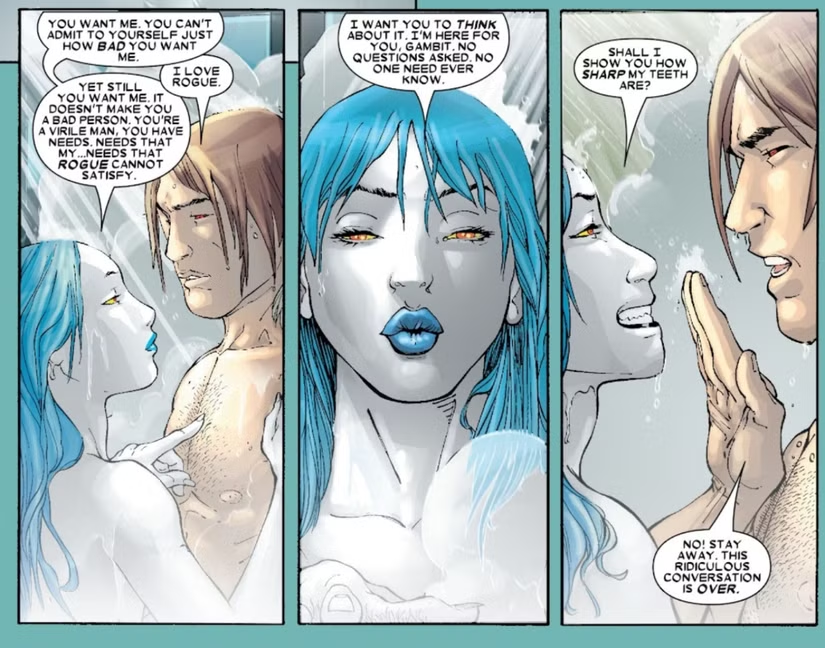
Again:
Rogue’s adoptive mother tries to seduce Rogue’s boyfriend as another woman.
Thanksgiving must be incredible in this family.
The Golden Rule of Rogues Power. What Year is it?
This became one of our favorite running jokes during the episode because it’s legitimately the easiest way to understand Rogue continuity.
Can Rogue safely touch somebody?
What year is it?
Does Rogue still have Carol Danvers’ powers?
What year is it?
Can she control her absorption?
What year is it?
Does she have Wonder Man’s powers?
WHAT YEAR IS IT?
Marvel has given Rogue control, taken it away, changed her permanent abilities and reworked how her absorption functions multiple times.
Eventually, during the X-Men Legacy era, Rogue makes huge progress.
Professor Xavier helps her work through psychological blockages associated with her powers, and Rogue finally reaches a point where physical contact doesn’t automatically mean absorbing someone.
For the girl whose first kiss put Cody Robbins into a coma, that’s enormous.
It’s something most people never think about:
Rogue finally gains the ability to choose.
She can touch somebody she loves without automatically hurting them.
For Anna Marie, that’s practically a superpower by itself.
That Time Rogue Absorbed Billions of Minds
Of course, Marvel can’t allow Rogue to experience stability for too long.
Eventually her absorption goes completely off the rails.
Enter Hecatomb.

Rogue absorbs the entity—and with it, billions of consciousnesses.
One Carol Danvers living inside her had nearly broken her.
Now imagine billions.
Rogue becomes overwhelmed, and the situation ultimately involves Hope Summers helping reset and restore her.
It’s one of those wonderfully insane comic-book moments where Rogue’s basic power concept gets pushed to its logical extreme.
What happens when a woman capable of absorbing another person’s mind absorbs something containing billions of them?
Nothing good.
Why Can Rogue Still Fly and Have Super Strength?
Here’s another Rogue question that sounds simple until you actually read comics.
If Rogue’s famous strength and flight originally came from Carol Danvers, why does modern Rogue still fly around punching things through buildings?
Everybody together now:
WHAT YEAR IS IT?
Rogue’s powers evolve repeatedly.
For a period she absorbs Sunfire, giving her access to his solar and plasma-based abilities.
Later comes Wonder Man, Simon Williams.
Rogue absorbs him as well, and his ionic abilities eventually become hugely important to her modern baseline power set.
That means asking, “Where did Rogue get her super strength?” has two major answers depending on the era you’re talking about:
Originally: Carol Danvers.
Later: Wonder Man becomes enormously important.
Marvel’s Rogue reading material spans exactly this kind of constantly changing power history—which is why trying to reduce Rogue to “the X-Man who steals powers” misses half the fun.
Rogue Becomes an Avenger And Everything Comes Full Circle
Now remember Avengers Annual #10 from 1981.
Rogue attacks Captain America. Absorbs him without permission. Knocks him unconscious.
Decades later?
Rogue becomes an Avenger.
She joins the Avengers Unity Division, a team specifically designed to bring Avengers, mutants and eventually other superhuman communities together. Marvel identifies Uncanny Avengers #1 as the first appearance of the Avengers Unity Squad.
But simply joining the Avengers isn’t the real payoff.
During a massive crisis, Avengers and X-Men willingly allow Rogue to absorb their abilities.
Think about how perfect that is.
Young Rogue takes people’s powers.
Adult Rogue stands among Earth’s greatest heroes…
and they give them to her.
Voluntarily.
Because they trust her.
And one of those people is Steve Rogers. The man she once attacked.
Eventually Rogue goes even further and becomes a leader of the Avengers Unity Squad.
Captain America trusts Rogue with leadership. That’s an incredible transformation.
The supervillain who debuted attacking the Avengers eventually becomes the woman trusted to lead them.

Rogue and Gambit Steal Someone Else’s Wedding
After roughly three decades of:
“I love you.”
“I don’t trust you.”
“I can’t touch you.”
“Maybe Magneto?”
“Absolutely not Magneto.”
Marvel finally decides enough is enough.
Kelly Thompson’s Rogue & Gambit series forces the pair to actually confront their relationship baggage—trust, trauma, intimacy and their respective pasts.
And that leads to one of the greatest wedding thefts in comic-book history.

In X-Men: Gold #30, Kitty Pryde and Colossus are supposed to get married.
Huge X-Men wedding.
Everybody’s there.
And then…
They don’t.
Gambit looks around at the guests, ceremony and perfectly usable wedding setup and apparently decides:
Well, somebody should use this thing.
He proposes to Rogue.
She says yes.
Rogue and Gambit effectively hijack Kitty and Colossus’ failed wedding and get married instead.

Marvel officially bills X-Men: Gold #30 as “The Wedding of Rogue and Gambit,” and their married adventures continue directly into Mr. & Mrs. X.
Honestly?
Perfect Rogue and Gambit behavior.

Modern Rogue: From Mystique’s Weapon to X-Men Leader
Rogue’s story doesn’t stop with the ’90s cartoon or the Fox X-Men movies.
Far from it.
She remains important throughout the Krakoan era, and when Marvel launched its new Uncanny X-Men era in 2024, Rogue was once again placed near the center of the team.
Marvel describes Uncanny X-Men #1 as a story where a core group of X-Men rise in a world without Professor Xavier.
Think about how far that takes Anna Marie.
The scared runaway who was molded into Mystique’s weapon eventually becomes the experienced mutant younger X-Men can look toward for leadership.
And Marvel still isn’t finished forcing her to confront her past.
A new Rogue solo series launched in 2026, while Marvel’s current catalog also includes Rogue: The Savage Land, Rogue & Gambit, her earlier solo books and decades of X-Men appearances.
Forty-five years after her debut, Rogue’s past still matters.
She simply gets to decide what that past means.
Why Rogue’s Entire Marvel Story Is Really About Trust
This was the thing that surprised us most while researching the episode.
Rogue’s story isn’t really about being unable to touch people.
It’s about trust.
Young Rogue accidentally hurts Cody.
Then she intentionally hurts Carol Danvers.
She takes powers from people who never offered them.
People fear physical contact with her.
The X-Men don’t trust her.
Then Xavier does.
And Rogue spends decades earning everybody else’s trust.
Gambit trusts her.
The X-Men trust her.
The Avengers trust her.
Captain America trusts her.
Eventually heroes willingly give Rogue the exact thing she once stole from people:
their power.
Young Rogue takes.
Adult Rogue is trusted.
That’s the character.
Her mutation physically violates boundaries, which means her entire life forces her to confront questions most superheroes never have to consider.
Who can I touch?
Why?
For how long?
What am I allowed to take?
What happens to that person afterward?
Eventually Rogue gains enough control that physical contact becomes something she can choose instead of something she has to fear.
That’s one hell of a character arc.
And Yes… We Have to Talk About Animated Rogue
After roughly 45 years of Marvel history, we finally arrive at one of Rogue’s greatest contributions to popular culture.
Her butt.
Specifically:
animated Rogue’s butt.

To be clear, there is no legendary Earth-616 comic called Rogue’s Ass #1 sitting in a CGC 9.8 slab somewhere.
Although the variant-cover possibilities would be incredible.
The internet obsession largely comes from X-Men: The Animated Series, which debuted in 1992 and helped define Rogue for an entire generation.
Huge hair. White streak. Green and yellow costume. Southern accent. Massive personality.
And apparently some extremely memorable animation choices.
The animated series helped make that version of Rogue the Rogue many fans still picture today.
That’s also why the Fox movie version felt dramatically different.
Movie Rogue emphasized the frightened young mutant struggling with her inability to touch people.
Comic Rogue eventually becomes a flying powerhouse who has fought gods, led X-Men and Avengers, absorbed some of Marvel’s most powerful characters and survived decades of completely insane mutant nonsense.
And that’s the Rogue we hope future adaptations aren’t afraid to embrace.
Rogue Comics to Hunt: The Essential Keys
Now that you know why these books matter, here’s the part for collectors.
If you’re digging through comic-shop bins, hitting a convention or building a Rogue collection, these are the books we’d be looking for.
Avengers Annual #10 (1981)

THE Rogue key.
This is Rogue’s first published appearance, written by Chris Claremont with art by Michael Golden.
She’s a villain.
She attacks the Avengers.
She absorbs Captain America.
And it begins a character arc that eventually leads directly to Rogue becoming an Avenger herself.
If you’re spending serious money on one Rogue book, this is the cornerstone.
Hunt Priority: ★★★★★
Uncanny X-Men #158 (1982)

An important early Rogue appearance and her first appearance within the flagship X-Men title before she officially joins the team.
It doesn’t carry the weight of her first appearance, but it’s an excellent early Rogue book to add after Avengers Annual #10.
Hunt Priority: ★★★★☆
Uncanny X-Men #171 (1983)

If Avengers Annual #10 is Rogue’s biggest collector key, this might be her most important character key.
Rogue turns to Xavier for help and joins the X-Men.
This is the pivot.
Villain Rogue begins becoming the hero we know today.
Best of all, this book has historically remained much more approachable than her first appearance.
Hunt Priority: ★★★★★
Uncanny X-Men #185 (1984)

An important Rogue character issue dealing with Cody Robbins and the trauma surrounding the manifestation of her powers.
If you collect Rogue because you love her story rather than simply chasing expensive keys, don’t overlook this one.
Hunt Priority: ★★★☆☆
Uncanny X-Men #269 (1990)

Rogue returns after the Siege Perilous and confronts the bizarre physical manifestation of the Carol Danvers identity that had lived within her.
This book also feeds directly into the Savage Land/Magneto period.
Weird X-Men continuity?
Absolutely.
Important Rogue history?
Also absolutely.
Hunt Priority: ★★★★☆
X-Men #24 (1993)

One of the definitive Rogue and Gambit books.
The two discuss their relationship over gumbo, and Andy Kubert’s Rogue/Gambit cover has become an iconic image of the couple.
This is exactly the type of book we love hunting: not necessarily some enormous first appearance, but a comic that instantly represents why people love the characters.
Marvel includes it in Rogue’s official recommended reading.
Hunt Priority: ★★★★☆
Rogue #1 (1995)

Rogue finally gets her own solo limited series.
And because this is 1995…
FOIL.
The gold-foil Rogue #1 is pure ’90s Marvel goodness and remains a fun, generally approachable Rogue collectible.
This isn’t the book that’s going to pay off your mortgage.
It’s the book you’re going to enjoy pulling out of a long box.
Which is what comic collecting is supposed to be.
Hunt Priority: ★★★★☆
Rogue & Gambit #1 (2018)

Kelly Thompson finally forces Marvel’s favorite dysfunctional X-couple to deal with decades of relationship baggage.
It’s a great modern Rogue/Gambit read and directly helps set up what happens next.
Hunt Priority: ★★★☆☆
X-Men: Gold #30 (2018)

The wedding.
Kitty and Colossus don’t get married.
Rogue and Gambit say, screw it.
Marvel officially identifies this as Rogue and Gambit’s wedding issue.
For modern Rogue collectors, this is an easy one.
Hunt Priority: ★★★★☆
Mr. & Mrs. X #1 (2018)

Rogue and Gambit’s marriage actually sticks, and their story continues into their own series.
If you’re building a Rogue/Gambit collection, grab this immediately after X-Men: Gold #30.
Hunt Priority: ★★★☆☆
If You Only Buy Three Rogue Comics…
We’d make it incredibly simple.
Avengers Annual #10 — First appearance of Rogue. The grail.
Uncanny X-Men #171 — Rogue joins the X-Men. The character-defining issue.
X-Men #24 — Iconic Rogue and Gambit, classic ’90s X-Men and one hell of a cover.
Three books.
Three different eras.
And together they tell you a surprising amount about why Rogue became one of Marvel’s greatest X-Men.
From Villain to X-Man to Avenger
Rogue enters Marvel Comics as a villain who steals other people’s powers.
She hurts Carol Danvers.
She attacks Captain America.
She joins the X-Men when almost nobody trusts her.
She fights for years to prove Xavier wasn’t wrong for giving her a chance.
She falls in love.
She gets her heart broken.
She deals with Magneto.
She deals with Gambit.
She deals with Mystique—which honestly might be worse than either of those.
She absorbs superheroes, aliens, gods and billions of consciousnesses.
She learns to control the very touch she spent her life fearing.
She becomes an Avenger.
And eventually she becomes someone Captain America trusts to lead.
That’s why Rogue has survived more than four decades of Marvel continuity. Just a straight up badass if you haven’t gathered that yet.
Not because she has cool hair.
Not because she can fly.
Not because of the Southern accent.
And despite what the internet might tell you…
not because of the peaches. Apocalypse will forever be happy about that.
It’s because underneath all the absurd X-Men bullshit is one of Marvel’s best redemption stories.
Young Rogue took power from people.
Adult Rogue became someone they willingly trusted with it.
And that’s Rogue. From the wise words of Matisyahu … Out of darkness comes light twilight unto the heights. She really evolved into one of the most incredible characters out there. You’d never know it either if you just watched the movies. So read comics my people! Or as we usually say at Comics & Brews, Read Brews, Drink Comics.
Watch Comics & Brews: The Drunk History of Rogue
Want the considerably less sober version of everything you just read?
Watch Episode 35 of Comics & Brews: Rogue’s Insane Marvel History — From Villain to X-Men & Avengers Leader.
We dive into Rogue’s comic history, Carol Danvers, Mystique and Destiny, Savage Land Magneto, Gambit, her constantly changing powers, the Avengers, her modern Marvel history and—because apparently we’re children—the cultural importance of animated Rogue’s ass.
All while drinking two completely irresponsible beers from Adroit Theory Brewing.
Comics. Craft beer. Questionable explanations of superhero history. Just scroll on back to the top of this blog post and you’ll see the video!
🔗 Connect With Us
Every follow and subscriber helps! We truly appreciate each and every one of you. Each channel posts something different here and there too so why not give em all a follow?
Website: www.comicsandbrews.co
Instagram: https://www.instagram.com/comics_brews
X: https://x.com/comics_brews
Facebook: https://www.facebook.com/profile.php?id=61552736760818
TikTok: https://www.tiktok.com/@comicsandbrews
Subscribe to Our YouTube Channel!
👉 Subscribe on YouTube for exclusive giveaways. It’s super easy too … Just hit that button below baby!





Leave a Reply